
Home — Blog — Coins on a headstone — what they mean and why people leave them there
Coins on a headstone — what they mean and why people leave them there
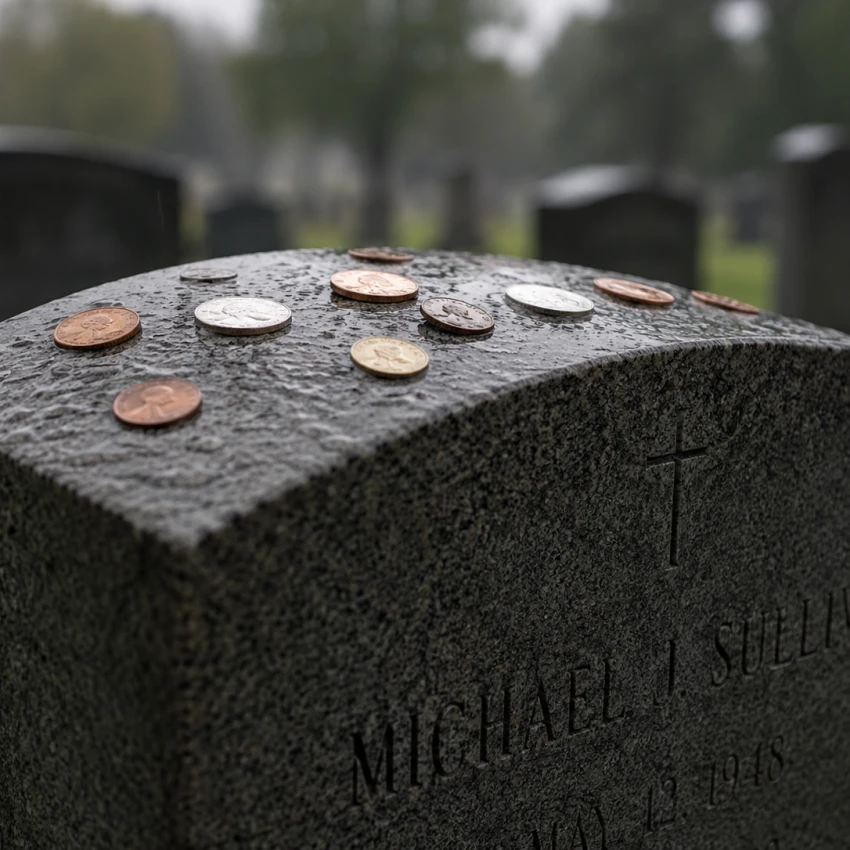
I first noticed them at a veterans' cemetery in Northern California. A flat granite marker, low to the ground, dark polished surface still catching the early light — and along the upper edge, four coins arranged with a care that was obviously deliberate. A penny. Two dimes. A quarter. They weren't dropped by accident. The arrangement was specific, intentional, and meaningful in a way I couldn't immediately put words to.
That's usually where this topic begins for most people. You see a coin on a headstone, either you already know what it means or you stand there for a moment and try to work it out. When you look it up, the answer turns out to be richer than you expected, layered with military history, ancient tradition, and a kind of quiet human language that people pass down without ever formally teaching it.
Coins on headstones are one of the most significant and least-explained traditions in American cemetery culture. Especially in military sections. Not everyone who visits knows the practice. Not everyone who leaves a coin could fully explain their own reason for doing it. Some things carry meaning before they carry words.
What coins on headstones mean and where the practice began
The act of placing objects at graves goes back further than most people think about. Across ancient Mediterranean and European cultures — Greek, Roman, Egyptian, Slavic — people placed items with or near the dead as tribute, protection, and provision for what came next. The most familiar version of this to Western readers is probably the Charon's obol practice from ancient Greece: a coin placed on the eyes or in the mouth of the dead so they could pay the ferryman for passage across the river into the afterlife. That image — coins left at the threshold between living and dead — runs through funerary tradition for centuries.
The modern American meaning of coins on headstones is more grounded than that, but it carries the same essential impulse. Coins on headstones meaning, in the contemporary context, is primarily about tribute and presence — a way of saying "I was here." The coin stays. It doesn't wilt or blow away. Weeks later, months later, a family member visiting the grave can see the coins left on headstones by others and understand, without a word being spoken, that other people came. The stone becomes a record.
This tradition took on more specific and formalized language during and after the Vietnam War era, particularly within US military communities and the cemeteries where veterans are buried. The denomination system — which coin means what, who should leave which one — became widely transmitted through that period and has held ever since.
Coins on military headstones — the American tradition that spread worldwide
There is a specific version of this practice that lives almost entirely within the language of military service, and coins on military headstones carry a denomination code that most veterans and their families now recognize. Each coin says something different about the relationship between the visitor and the person they came to see.
A penny left on a military headstone means the simplest thing: someone visited. Someone came to this grave, in Texas or Pennsylvania or North Carolina or wherever the stone stands, and they stood here. The penny is the most common coin left, the most universal, the most accessible gesture in the code.
A nickel means you and the deceased trained together — the same boot camp, that shared experience of formation that bonds people in ways civilians find hard to understand. Leaving a nickel is an acknowledgment of a beginning you shared. A dime says you served together in some capacity, that your service lives overlapped and touched.
And a quarter — that's the heaviest one. A quarter left on coins on a military headstone means you were present when they died. You were there. You carry it. A quarter at a military grave tells anyone who knows this language that someone came carrying something most people will never have to carry. I've stood next to stones with quarters on them and felt the weight of that, honestly, in a way that's hard to describe.
Coins collected from veterans' headstones in some national cemeteries are used to help cover burial costs for indigent veterans — those who died without family or funds for a proper burial. The coins continue serving the veteran community after they've been gathered. That's not incidental. It's exactly right.
Rocks and coins on headstones and how the traditions are related
Rocks and coins on headstones often appear together at the same grave, and people who encounter both sometimes wonder if they carry the same meaning. They don't — they come from different cultural traditions, different histories, different communities. But both are acts of tributed presence, and both accomplish something similar: they make a visit visible.
The practice of leaving a small stone on a grave marker is primarily rooted in Jewish cemetery tradition. The explanation most commonly given is that in ancient desert burial practice, rocks were piled on graves to protect them from animals, and adding a stone continued that protective gesture through the generations. Other interpretations suggest that stones — unlike flowers, unlike food, unlike most perishable offerings — last indefinitely. They don't wilt. They accumulate across visits, each one a permanent marker of someone who came. The act of picking up a stone and placing it deliberately is a small physical ritual, brief but weighted, that honors the gravity of standing at a grave.
Rocks and coins on headstones at the same grave usually mean that multiple communities came — Jewish friends or family members leaving stones, military comrades leaving coins, both traditions meeting at a single marker. I've seen this in cemeteries in New Jersey and California, in the older sections where communities have overlapped for generations. You can read the whole social world of a person's life in what's accumulated on their stone.
The significance of coins on headstones and what each denomination says
The significance of coins on headstones is partly official — military tradition, denomination code, accumulated history — and partly personal in a way that each visitor shapes individually. For people within the military community, the code carries real weight. Leaving the right coin is a deliberate act of precision. Leaving the wrong coin, if you knew the system, would feel incorrect in the way that wearing the wrong rank insignia would feel incorrect — it would misrepresent something true.
For civilians who adopt the practice, coins on headstones meaning tends to be less tied to denomination and more tied to the act itself. A penny from the year the person was born. A commemorative quarter from a state they loved. A foreign coin from a country where they served or traveled. The coins headstones meaning becomes privately coded — only the visitor knows the full significance of what they left, and that private knowledge is part of what makes the gesture personal rather than generic.
What do the coins mean on a headstone when no one left a denomination-specific message? They still mean someone came. The accumulation of coins on a headstone tells a story: this person was loved, was remembered, was visited. It's legible to anyone who stands long enough to look.
What do coins on a headstone mean when left by different people
What do coins on a headstone mean when they come from different people, different relationships, different generations? The answer is that meaning stacks. A military comrade leaves a nickel and says: we trained together, I haven't forgotten. A grandchild leaves a penny and says simply: I came. A friend from a different part of the deceased's life leaves a coin with no denomination significance intended and says only: I miss you, I was here today.
What does coins on a headstone mean in the context of a civilian grave with no military connection at all? Often the same thing — someone absorbed the practice from somewhere, felt it was the right gesture, and did it. The tradition spreads this way. Meaning of coins on a headstone travels through families, through veteran communities, through anyone who stands at a grave and watches someone else leave a coin and thinks: yes, that feels right.
I've talked with people in their fifties and sixties who leave coins at military graves they visit — anywhere, in Sacramento, in Houston, in Tulsa — without consciously deciding to, because they watched a parent do it when they were children and the habit became part of how they understand a cemetery visit. What does a coin on a headstone mean for these people? It means continuity. It means they're carrying something forward.
Meaning of coins on headstones is also, simply, an acknowledgment that the stone is still a place worth visiting. That the person underneath it hasn't been reduced to a date and forgotten. Coins left on headstones make that visible in a way that flowers — gone in a week — can't sustain.
Why do people put coins on headstones today
Why do people put coins on headstones when other tributes exist — flowers, flags, personal items? Because coins stay. Physically, materially, visibly. They don't wilt in the heat of a Texas summer or wash away in an Ohio rainstorm. They sit on the stone and accumulate across visits, and each coin is a small, permanent record.
There's also something in the gesture itself. Reaching into a pocket, finding a coin, holding it for a moment, placing it carefully on the stone — it's a physical act of presence. Leaving coins on a headstone requires you to actually be there. To walk up to the grave, to get close, to touch the stone or nearly touch it, to make a deliberate choice about what you're leaving. You can't phone it in.
Why do people put coins on headstones in veterans' cemeteries specifically? Because visiting a fallen comrade's grave is, for many veterans and their families, a duty. And leaving something behind is the outward evidence of that duty done. The coin is proof of presence. Leaving coins on headstones becomes, in this context, as formal and intentional as a salute — a gesture with rules, with meaning, with protocol that has been passed down.
And then — honestly — some people do it simply because they saw it done and it felt like the right language. The tradition self-propagates exactly this way. Someone new to a military cemetery sees coins on military headstones, asks what coins on headstones mean, learns the code, and carries it forward. The meaning multiplies through observation and inheritance rather than instruction. What do coins mean on a headstone? Whatever was true for the person who left the last one.
Coins on a military headstone — the quarter especially — represent something that can't be fully absorbed from the outside. But standing at a stone where one has been left, you can feel the edge of it.
The headstone itself — what makes a grave site worth returning to
All of this — coins, rocks, flowers, flags, the quiet deliberate acts people perform at grave sites across the country — depends entirely on the headstone being there. Standing correctly. Still readable after twenty or thirty years of frost, rain, sun, and the particular weather conditions of wherever the cemetery is. Still worth walking up to.
Coins left on headstones can only accumulate on a surface that holds them — a flat marker with enough of a ledge along the top edge, an upright with a base element that's level and stable. These aren't incidental details. A marker that's tilted from ground movement doesn't hold coins. A stone with lettering so shallow it's already fading at year ten isn't the kind of memorial that becomes a place people keep coming back to.
We work with funeral homes, cemeteries, and memorial partners from 14 locations across the country — Sacramento, California; Houston, Texas; Tulsa and Edmond in Oklahoma; and service coverage across Florida, Ohio, Pennsylvania, New York, Illinois, South Carolina, New Jersey, Washington, Kansas, and Arkansas. The H-Stones B2B catalog covers flat granite markers, bevel markers, upright monuments, and military-appropriate pieces in materials that are rated for outdoor permanence — Indian Black, Shanxi Black, G603 Sesame White, and over 40 other exterior-grade granites sourced from certified quarries.
Every product in the catalog has a 3D model view and AR preview built into the product page — the finished stone rendered with selected material, from every angle, placed in a real environment through a phone camera before a single order is placed. For families and partners who understand that a grave site is going to be visited, regularly, with intention and with coins and stones and flowers across decades — the quality of the stone that starts all of that matters more than most people think about at the time of purchase. A place worth returning to begins with a stone made to last.
Frequently asked questions about coins on headstones
What do coins on a headstone mean at a military grave?
Each denomination carries specific meaning in the military context. A penny marks a visit — someone was here. A nickel means you trained with the deceased at the same boot camp. A dime means you served together. A quarter — the most significant — means you were present when they died. This denomination code became widely established through US military culture during and after the Vietnam War era.
What does leaving coins on headstones mean outside of military cemeteries?
In civilian contexts, leaving a coin on a headstone is primarily a mark of visitation — an act that says "I came, I was here, I remember you." Some visitors leave coins with personal significance: a birth-year coin, a commemorative piece, a foreign coin tied to a place the deceased loved. The meaning is less codified than in military practice but no less genuine.
Why do rocks and coins appear together on the same headstone?
Rocks and coins on headstones come from distinct traditions. Leaving a small stone is rooted in Jewish cemetery practice, where it marks a visit and indicates the deceased is remembered. Leaving coins is associated primarily with American military culture but has spread broadly. Both traditions together at one grave simply mean that visitors from different backgrounds or communities came to the same stone.
Are coins collected from military headstones?
Yes — cemetery staff at many veterans' cemeteries collect accumulated coins periodically. In some cases, the funds are used to help cover burial costs for veterans who died without family or resources for a proper burial. The coins serve the veteran community in a practical way even after they're gathered.
Why do people put coins on headstones rather than flowers or other tributes?
Coins stay. They don't wilt, blow away, or disappear between visits. A coin left at a grave is still there weeks later when another visitor comes — it serves as visible evidence that others have visited, and that accumulation tells its own story about how remembered someone was. The physical act of placing a coin also requires being genuinely present at the stone in a way that more passive tributes don't.
How does the quality of a headstone affect whether it becomes a meaningful place to visit?
Significantly. A grave marker that tilts from poor installation or shallow foundation prep, or one whose lettering is already fading at year ten, doesn't invite repeated visits the way a well-made, properly installed stone does. Dense exterior-grade granite, adequate thickness, properly cut engraving, and correct installation all contribute to a memorial that holds up and remains worth approaching. H-Stones produces across 40+ granite materials with full 3D and AR preview tools on every product page for partners and families who want to see the finished stone before committing.
-
-
Affordable Headstones Near Me — the Search That Deserves Better Answers Than Most People Get
Read more